
Legacy Site Structure Cleanup for Search and AI Visibility
Serving Fairfield County CT, Westchester and Putnam County NY, but also nationwide
For Sites not sure they need a Redesign or just a clean up….
Your site wasn’t built for how Google and AI systems read the web today. We untangle years of add-on pages, tangled URLs, and crawl waste so search engines and LLMs can finally see the value that’s already there.
Most legacy sites didn’t get messy on purpose. A new section here, a campaign landing page there, a plugin that spun up thousands of tag pages, a redesign that kept the old URLs “just in case.” Ten years later, the structure is doing the opposite of its job: hiding your best pages instead of featuring them.
We approach a legacy cleanup like a renovation on an old house. First we figure out what’s load-bearing (the pages, links, and URLs carrying your rankings and backlinks). Then we rebuild around them so nothing important collapses.
Believe in our demonstrated outcomes
Why Legacy Structure Costs You Rankings and AI Citations
Search engines and AI systems reward sites that are easy to crawl, easy to understand, and clear about which pages matter most. Legacy structures fail all three tests, usually in the same predictable ways:
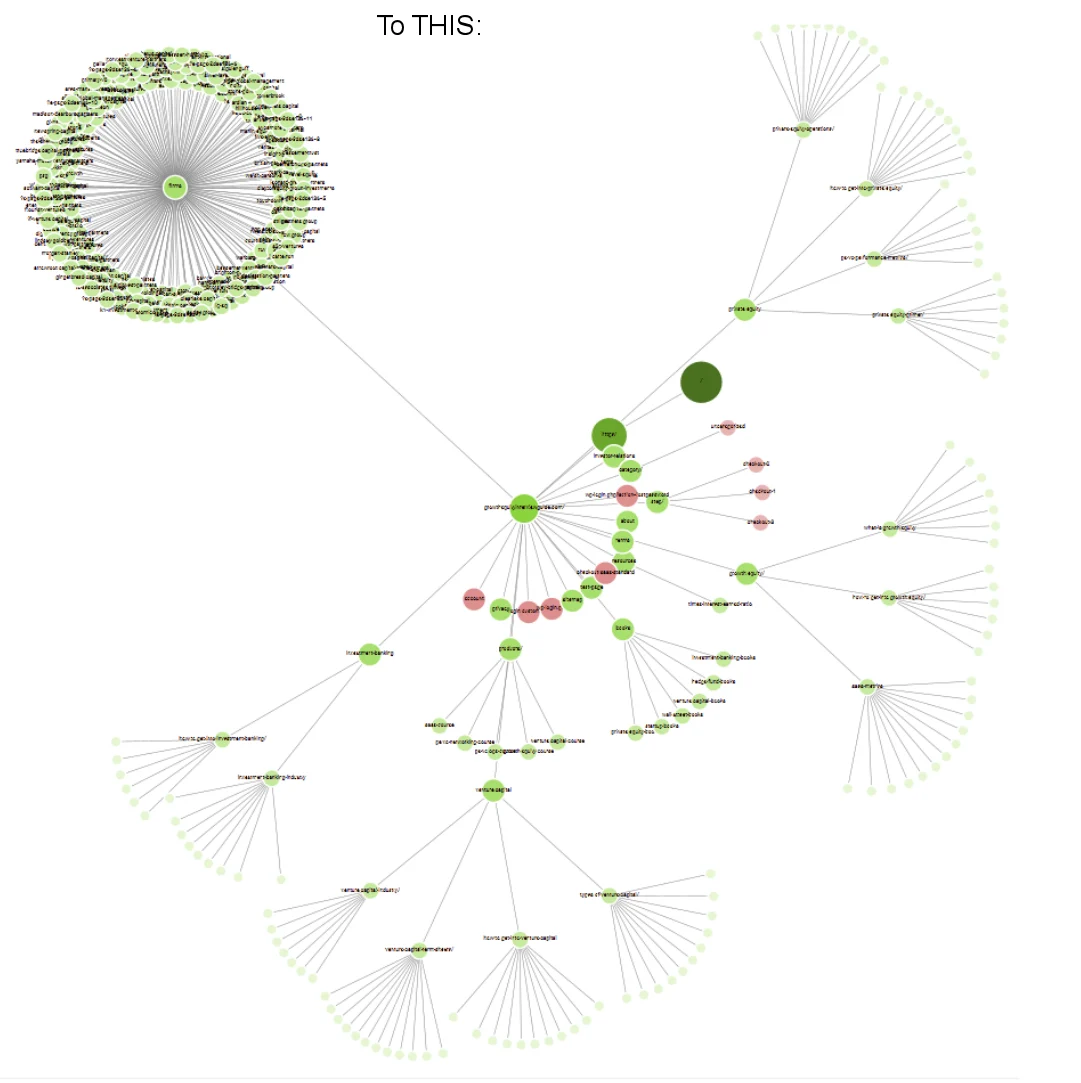
- Crawl waste. Thousands of thin, duplicate, parameter, tag, and archive URLs compete with your real pages for crawl attention. Your best content gets visited less often and refreshed more slowly.
- Flat or tangled hierarchy. When everything links from the homepage or nothing links to anything, there’s no signal about which pages are pillars and which are supporting detail.
- Pages buried too deep. Important service or product pages sitting five or six clicks from the homepage get treated as afterthoughts.
- Redirect chains and orphaned URLs. Each past redesign layered on new redirects. Link equity leaks with every hop, and pages with strong backlinks end up pointing nowhere.
- Content locked behind JavaScript. Older themes and newer page builders often load key copy, tabs, and navigation with scripts. Google can usually render it. Most AI crawlers don’t.
- Low-value pages dragging down quality signals. Outdated posts, auto-generated pages, and near-duplicates tell search engines the site as a whole is less trustworthy.
Google has always been somewhat forgiving of this mess. AI-driven search is not. LLMs pull from what they can read cleanly and cite pages that clearly answer a question. If your structure hides that page, a competitor’s cleaner site gets the mention instead.
How AI Systems Actually See Your Website
Most AI crawlers read your raw HTML and stop there. Independent crawler research from Vercel found that bots like GPTBot, ClaudeBot, and PerplexityBot download JavaScript files but don’t execute them. Google is the exception: it renders pages in a headless browser, but Google itself recommends server-side rendering because not every bot can run scripts.
That means your site effectively has three versions, and AI tools often only see the first:
- The source HTML: what your server sends before any scripts run. This is what most AI crawlers read.
- The rendered page: what exists after JavaScript builds the page. This is what Google and your visitors see.
- The text-only skeleton: what’s left if scripts fail or get ignored.
If your headings, service descriptions, FAQs, pricing, internal links, or schema only appear in version two, many AI systems will miss them entirely. Part of every legacy cleanup we do is comparing these versions page by page, then moving discovery-critical content into the server-rendered HTML.
Our rule of thumb: strip out all the JavaScript. If the page still clearly says what you do, what the page is about, and where the important links go, AI systems can understand it too. If it doesn’t, that’s where we start.
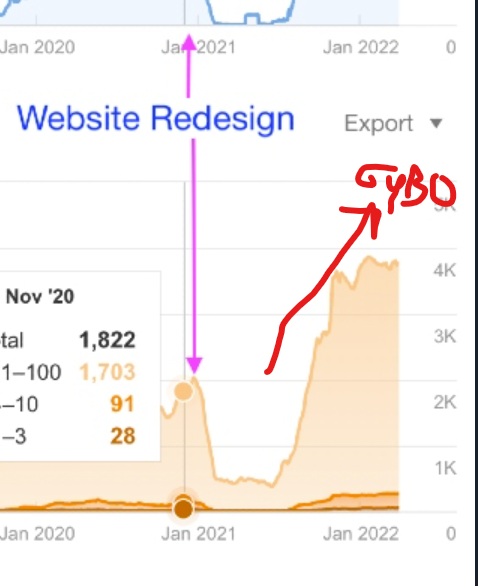
Case Study: 319% Organic Traffic Lift From Architecture Fixes
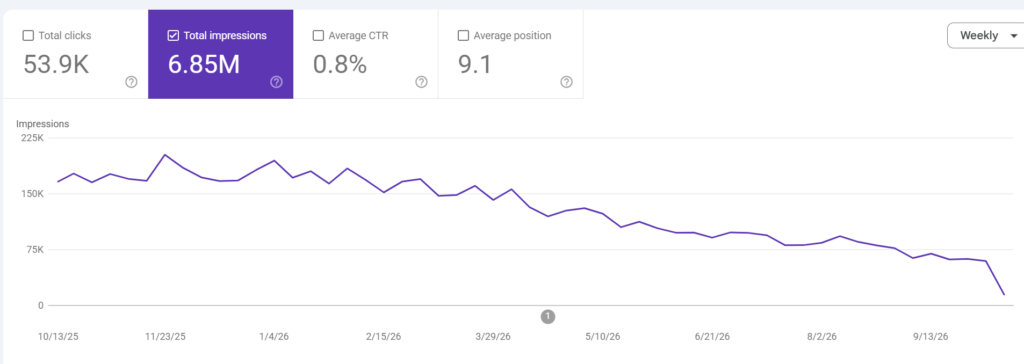
A large educational finance site arrived with strong demand, but a painful trend: six months of steady organic decline and visibility losses after recent Google updates. The content itself wasn’t the whole problem—the architecture and crawlability were.


In the client’s words, we were “experts in technical SEO”—and what changed wasn’t the brand or offer, but the structure that finally let search engines see the value that was already there.
How We Work
How We Clean Up a Legacy Site Structure
We sequence every change to protect the rankings you already have while removing what’s holding you back.
01
Crawl and inventory everything.
We crawl the full site, pull every indexed and linked URL from Google Search Console, and review server logs where available. You get a complete picture of what exists, what Google is actually crawling, and what’s earning traffic and links.
02
Compare what bots see versus what people see.
We check source HTML against rendered HTML on your key templates to find content, links, and schema that only exist after JavaScript runs.
03
Decide keep, consolidate, or retire.
Every URL gets a verdict based on traffic, rankings, backlinks, and business value. Weak and duplicate pages get merged into stronger ones or removed.
04
Design the new architecture.
We build pillar pages and topic clusters around how your customers search, keep important pages within three clicks of the homepage, and set clean, readable URL patterns.
05
Map every redirect before anything moves.
One-to-one 301s from old URLs to their best new match, existing chains collapsed into single hops, and backlinked pages protected first.
06
Rebuild internal linking.
Real <a href> links connect supporting pages to their parents and to each other, so both crawlers and readers can follow the logic of the site.
07
Control what gets indexed.
Canonical tags, noindex on low-value pages, cleaned-up tag and parameter URLs, and an XML sitemap that only lists pages worth ranking.
08
Build the AI-ready layer.
Critical content moves into server-rendered HTML, structured data goes into the page source, AI crawler access is set intentionally in robots.txt, and an llms.txt file points AI tools to your most important pages.
09
Launch, monitor, and adjust.
We watch crawl stats, indexing, rankings, and traffic after launch, then fix anything that slips before it becomes a trend.
Because our team has a web development background, we can implement this directly in WordPress, Squarespace, Kajabi, Shopify, and custom builds, or work alongside your developers.
Signs Your Site Needs a Structure Cleanup
- Traffic has slowly declined for months, and new content isn’t reversing it
- Google Search Console shows far more indexed or “crawled, not indexed” URLs than pages you’d actually want ranking
- You’ve been through two or more redesigns or CMS changes without a full redirect audit
- Your blog has hundreds of tag, category, or archive pages that nobody visits
- Key pages are hard to reach from your navigation, or only show up in site search
- ChatGPT, Perplexity, or Google AI Overviews describe your business vaguely, incorrectly, or not at all
- Competitors with less experience show up in AI answers for questions you should own
If two or more of these sound familiar, the bottleneck is likely structural, not a content problem.
FAQ
Will restructuring my site make me lose rankings? Not if it’s planned properly. Rankings drop during restructures when URLs change without one-to-one redirects or when pages with backlinks get deleted. We map every redirect and protect your highest-value URLs before anything moves.
Do I need a full redesign to fix my site structure? Usually not. Most legacy cleanups happen inside your existing design: consolidating pages, fixing URLs, rebuilding internal links, and controlling what gets indexed. If a redesign is already planned, we’d rather be involved before launch than after.
Why does site structure matter for AI search? Most AI crawlers read your raw HTML without running JavaScript, and they favor pages that clearly answer a specific question. A clean hierarchy with server-rendered content makes it far easier for ChatGPT, Claude, Perplexity, and Google’s AI features to understand and cite your pages.
How long until we see results? It depends on site size and how quickly changes can be implemented. In our financial education case study, ranking keywords grew 86% within weeks of the restructure, and traffic kept climbing from there.
What is llms.txt, and do I need one? llms.txt is a proposed standard: a simple file that summarizes your site and links to your most important pages for AI tools. It’s not a replacement for crawlable HTML, but it’s a low-effort addition we include as part of the AI-ready layer.
Can you work with our developers? Yes. We can implement directly in your CMS or hand your dev team a clear, prioritized spec and stay involved through launch.